
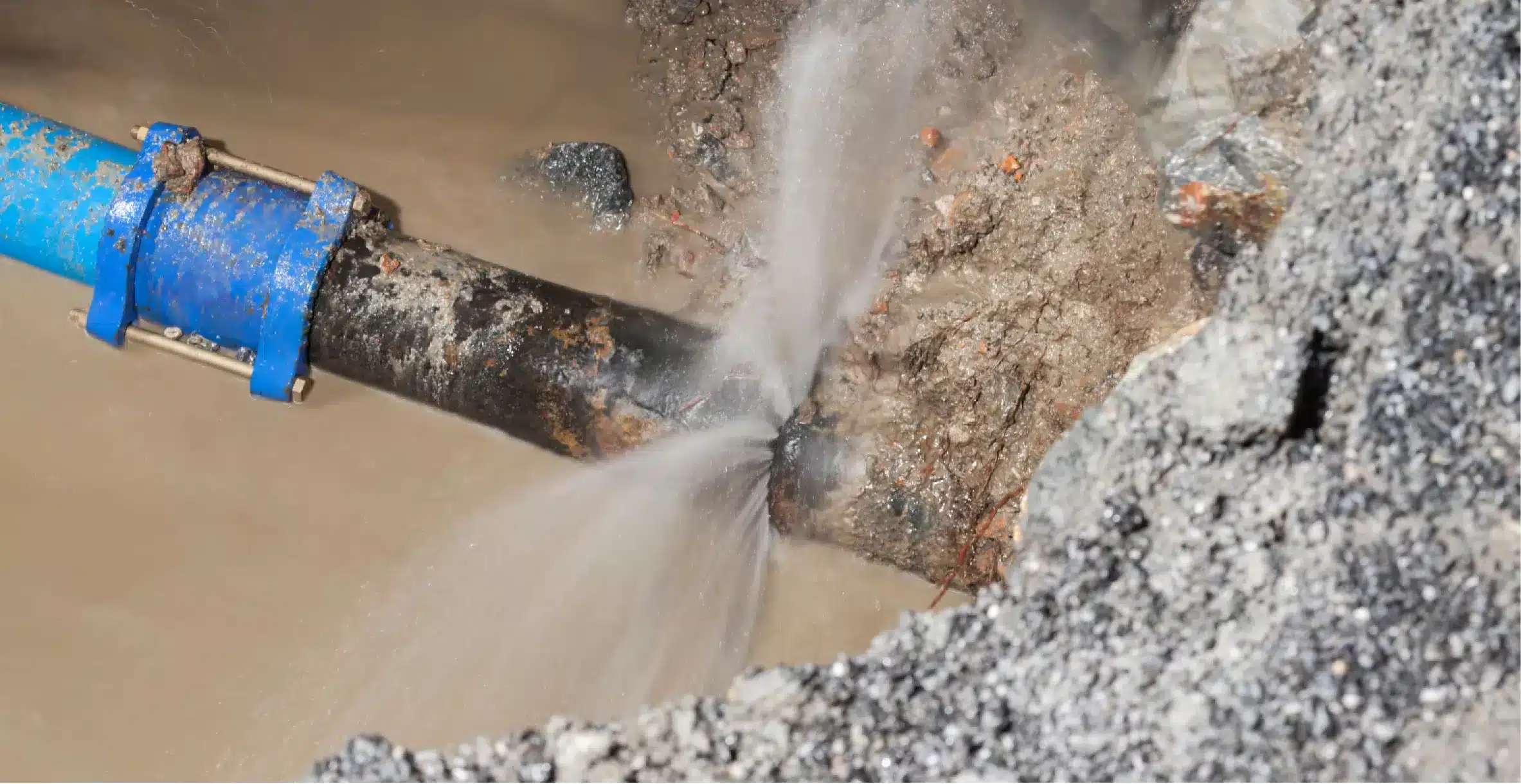
You can detect a slab leak early by watching for four warning signs: an unexplained jump in your water bill, warm or damp spots on the floor, a drop in water pressure, and the sound of running water when all fixtures are off. Acting quickly means less water soaks into the soil under your slab.
If your water bill is rising for no reason or you feel a warm floor under your feet, you might have a slab leak. Detecting it early matters because hard water and shifting clay soil constantly stress the pipes under your home.
Why are Slab Leaks Common in San Bernardino?
A slab leak is a water leak in a pipe running beneath or through the concrete foundation of your home. Most homes built on a slab have both fresh water supply lines and drain lines buried in or below that concrete. When one of those pipes corrodes, cracks, or shifts enough to break a joint, water starts escaping into the soil under your foundation.
Two local factors put our pipes under real stress. The first is water hardness. Local tap water is hard, loaded with dissolved minerals that build scale inside copper pipes and slowly attack the walls. This pitting corrosion forms tiny pits in the pipe wall, leading to pinhole leaks. The U.S. Environmental Protection Agency has documented how corrosion leads to pinhole failures, water damage, and mold in home plumbing.
The second factor is our soil. Much of the Inland Empire sits on expansive clay, which swells when it absorbs water and shrinks when it dries. During wet winters, the clay swells and pushes against the slab. In the long dry summers, it shrinks and pulls away.
That constant heaving puts sideways and vertical forces on the rigid pipes buried in the concrete. Copper lines, thinned by hard water, are more likely to snap when the ground moves. This causes many slab leaks in older neighborhoods.
What are the Warning Signs of a Slab Leak?
Most homeowners spot a slab leak because something feels off, not because they look for it. You rarely get every sign at once. Usually one or two appear, and any is worth taking seriously. The U.S. Environmental Protection Agency notes that 9% of homes have leaks wasting 50 gallons or more per day.
Slab Leak Warning Signs to Watch For
- An unexplained spike in your water bill: If your usage habits haven’t changed but your bill jumps, water is escaping somewhere unseen. This is an early and reliable warning sign of a slab leak.
- Warm or hot spots on the floor: A leak in a hot-water line beneath the slab can heat the concrete above it. If one area of tile or hardwood is noticeably warm, that’s a strong clue.
- Damp flooring, warped wood, or wet carpet: Moisture seeps up through the slab and saturates whatever is on top.
- Low water pressure: When water leaks before reaching your faucets, pressure at the fixtures drops. Persistent low pressure with no obvious cause deserves a look.
- The sound of running water when everything is off: Shut off every tap and appliance, then listen. A faint hiss or trickle under the floor suggests a pressurized line is leaking.
- Cracks in floors, baseboards, or walls: As water undermines the soil supporting your foundation, the slab can shift and crack the finishes above it.
- A musty smell or mold growth: Trapped moisture under and around the slab feeds mold, which often shows up as a smell before you see anything.
A warm spot plus a high bill, or low pressure plus the sound of running water, is enough reason to investigate.
How to Detect a Slab Leak? Run a Simple Water Meter Test
Before you call anyone, you can do one check that tells you a lot. It uses your water meter, usually near the curb or in a box in the yard. The EPA’s WaterSense program recommends checking winter water use, as a family of four using more than 12,000 gallons in a month likely has a serious leak.
Turn off every water-using fixture and appliance in the house: faucets, dishwasher, washing machine, ice maker, and irrigation. Then find your water meter and check the leak indicator, usually a small triangular or gear-shaped dial that spins when water moves. If it spins with everything off, water is flowing somewhere. Write down the meter reading, wait two hours without using water, then read it again. If the number changed, you have a leak.
This test confirms a leak but won’t show where it is. A spinning meter could be a running toilet or outdoor spigot as easily as a slab leak. To rule out fixtures, shut the valve at each toilet base and repeat the reading. If the meter stops, the problem is a fixture, not the slab.
If it keeps moving with every fixture isolated, the leak is on the main supply line, making a slab leak the top suspect. That’s where do-it-yourself ends. Pinpointing a leak under concrete without tearing up the floor requires specialized equipment and a professional.
How Do Professionals Find a Slab Leak?
Here’s what a real diagnosis looks like on site. A licensed plumber won’t start jackhammering the floor, hoping to get lucky. The point of professional leak detection is to find the exact spot before opening anything.
We start by isolating the system to confirm the leak is on a pressurized supply line, not a drain. Then we use electronic acoustic listening equipment with sensitive microphones that pick up the sound of pressurized water escaping beneath concrete.
For hot water leaks, thermal imaging maps the warm path water takes through the slab. Pressure testing on individual lines narrows down the culprit pipe. Together, these tools let us mark an X on the floor within a small margin so the repair opens as little concrete as possible.
Concrete Slab Leak Repair Options for Homeowners
Once the leak is located, you have a few repair options depending on the pipe’s age and condition. A spot repair opens the slab only at the point of failure. A reroute abandons the bad line and runs a new pipe through the wall or attic, bypassing the slab entirely.
If the plumbing is old and failing in multiple places, a whole-home repipe replaces the supply lines throughout the house. A trained plumber guides you through the best option instead of pushing the biggest job.
Here are your options:
| Spot repair | A single, isolated leak in otherwise sound pipe | Opening the slab at one location to fix that section | Lowest |
| Pipe reroute | One bad line where opening the slab is difficult | Running a new line through walls or attic, bypassing the slab | Moderate |
| Whole home repipe | Aging pipes failing in more than one place | Replacing all supply lines throughout the home | Highest, but most permanent |
In San Bernardino, plumbing work is regulated by the City’s Building and Safety Division with few exceptions. A simple pipe or fixture fix has a lighter path, but a reroute or whole-home repipe requires a permit and must pass inspection.
A licensed contractor pulls the permit, coordinates the inspection, and ensures the repair is on record, protecting your home’s value and future insurance claims.
Whole-Home Repiping Done Right: A Real Customer Experience
Not every slab leak is a simple one-pipe fix. John Lau’s home shows what a thorough diagnosis can uncover. He reached out with concerns beyond a single leak, worried about the overall plumbing condition beneath his house.
Mike, Sam, David, and the team inspected the home in detail rather than guessing. The job became nearly a full repipe under the home, replacing drain lines, the sewer line, and the water main. What stood out was how the decisions were handled.
In his words:
“They checked everything I asked in detail, isolated all issues, pointed out bad work from the previous owner(s), and made suggestions on the best way to approach repairs. At no point did I feel obligated to accept any work. They provided options and pointed out the necessary items while separating the optional items. Each and every one on the team was open to my questions at all times and made sure to answer them in a way I would understand.” Read John’s full Google review.
The result was a home with sound plumbing, clear documentation, and a homeowner who understood exactly what was done and why. That’s the outcome careful diagnosis should produce. You can learn more about our family-owned business and the way we approach every job.
Why Timing Matters So Much for Plumbing Leak Inspections
A slab leak is one of the few plumbing problems that worsen with time. The water wastes money, but also much more.
The higher cost is structural. Water pooling under the slab softens and erodes the soil supporting your foundation. As that support washes away unevenly, the slab can shift, cracking your floors and walls.
Caught early, a slab leak is often a targeted spot repair. Left for months, it can turn into foundation work that costs many times more.
Residential Slab Leak Services from a Team You Can Trust
Slab leaks are not a place to gamble on guesswork, and the plumber you call matters as much as how quickly you call. Showtime Family Plumbing and Rooter is a licensed Southern California contractor.
We provide fast, reliable slab leak detection and repair using advanced tools and minimal digging, plus whole-home repiping with complete documentation. If the repair is more extensive, we offer financing options to keep costs manageable.
Schedule your slab leak inspection today.
FAQs
How much does slab leak detection and repair cost in San Bernardino?
Costs vary widely depending on where the leak is and which repair method is used. Professional leak detection is a relatively small cost compared to repair and is worth doing because it prevents unnecessary demolition. A single spot repair on an accessible leak is far cheaper than a reroute or a whole-home repipe. Permit fees for larger jobs are a separate line item in San Bernardino. We locate the leak first before giving you a real number rather than a one-size-fits-all quote.
Can a slab leak fix itself or go away on its own?
No. A slab leak never resolves on its own, and it doesn’t stay the same size either. The pipe damage that caused it, whether corrosion from hard water or stress from shifting soil, continues once it starts. Water keeps escaping and eroding the soil under your foundation the entire time. Waiting only increases both your water bill and the eventual scope of repair, which is why prompt slab leak repair matters.
Is a slab leak covered by homeowners’ insurance?
It depends on your policy and the cause. Many homeowners’ policies cover the resulting water damage from a sudden slab leak, along with the cost of accessing the pipe, but often exclude the pipe repair itself and anything related to gradual wear or deferred maintenance. Because a slab leak caused by long-term corrosion may be treated as a maintenance issue, coverage is not guaranteed. Review your specific policy, talk to your insurer, and keep detailed documentation and before-and-after photos, since that record helps with any claim.
Do I need a permit to repair a slab leak in San Bernardino?
Often, yes. Under the California Building Standards Code adopted by the City of San Bernardino, most plumbing work requires a permit. A whole home repipe or a rerouted line is permitted work that must pass a city inspection. A licensed plumber handles the permit and inspection coordination for you.
Will I have to tear up my whole floor to fix a slab leak?
Not usually. The entire purpose of professional electronic leak detection is to pinpoint the leak so the repair opens up the smallest possible area. A spot repair on a single leak typically means accessing just that one location. In cases where opening the slab is impractical, a reroute bypasses the slab altogether by running new pipe through walls or the attic, avoiding concrete work entirely. We recommend the approach that fixes the problem with the least disruption to your home.
Key Takeaways
- A slab leak is a leak in a water pipe running beneath or through your home’s concrete foundation, and it will not resolve on its own.
- The four earliest warning signs are an unexplained increase in the water bill, warm or damp spots on the floor, reduced water pressure, and the sound of running water when all fixtures are off.
- San Bernardino’s very hard water drives pitting corrosion in copper pipes, while expansive clay soil shifts with the seasons; together, these two forces are a leading cause of local slab leaks.
- The U.S. Environmental Protection Agency has documented how copper pitting corrosion can lead to pinhole leaks, water damage, and mold in home plumbing systems.
- You can confirm a leak yourself with a water meter test: shut off all water, check that the meter reading doesn’t change over two hours. But a professional, using acoustic listening and thermal imaging, is needed to pinpoint it under the slab.
- In San Bernardino, most plumbing repairs beyond a simple fix require a building permit and must pass a city inspection under the California Building Standards Code.
- Early detection is the difference between a targeted repair and costly foundation damage, as water leaks erode the soil supporting your slab.
Citations and References
- U.S. Environmental Protection Agency, WaterSense Fix a Leak Week: household leaks waste nearly 1 trillion gallons of water annually nationwide. (Source: EPA WaterSense, https://www.epa.gov/watersense/fix-leak-week).
- U.S. Environmental Protection Agency, Copper Pitting Corrosion and Pinhole Leaks case study: localized pitting corrosion of copper drinking water pipe leads to pinhole leaks, water damage, and mold. (Source: EPA Science Inventory, https://cfpub.epa.gov/si/si_public_record_report.cfm?Lab=NRMRL&dirEntryId=135623).
- City of San Bernardino, Building and Safety Division: with few exceptions, building permits are required for all plumbing work under the California Building Standards Code, Title 24. (Source: City of San Bernardino, https://www.sanbernardino.gov/205/Building-Safety-Division).
- U.S. Environmental Protection Agency, WaterSense Program. (Source: https://www.epa.gov/watersense/home-maintenance).